Medically reviewed by Dr. Allison Williams, DDS, MSD, board-certified orthodontist.
If your dentist or orthodontist mentioned an expander, a Herbst, headgear, a retainer, or a name you have never heard of, you probably left the appointment with more questions than answers. Most parents do.
The truth is, an orthodontic appliance is just a tool. Some are fixed to the teeth, some come in and out, and each one has a specific job: widen a narrow jaw, guide growth, hold space for adult teeth, finish a tricky tooth movement, or keep a finished smile from drifting back.
At Sturgill Orthodontics in Johnson City, TN, our board-certified orthodontists fit and adjust the full range of appliances for kids, teens, and adults across the Tri-Cities, including Johnson City, Bristol, Kingsport, and Norton. We use 3D digital scans and in-house printing to make many appliances custom to the patient, which means a better fit on day one and fewer surprises later. This page walks through every common appliance, what it does, who it is for, and what to expect at home, written the way we explain it in the consult room.
If you are comparing options for orthodontic appliances in Johnson City, this guide will help you understand what each device does and when it may be recommended.
Schedule Your Free Consultation
Common Orthodontic Appliances at a Glance
Common orthodontic appliances include braces, Invisalign, retainers, palatal expanders, Herbst appliances, headgear, space maintainers, elastics, bite plates, and temporary anchorage devices (TADs). Some appliances move teeth, some guide jaw growth, and others protect the results after treatment.
Common appliances at a glance
| Appliance | Type | Primary Goal | Typical Age |
|---|---|---|---|
| Palatal Expander | Fixed | Widens a narrow upper jaw, corrects crossbite | 7 to 14 |
| Herbst Appliance | Fixed | Corrects deep overbite, guides lower jaw forward | 10 to 14 |
| Headgear / Reverse-Pull | Removable | Guides upper jaw growth (back or forward) | 7 to 12 |
| Forsus Spring | Fixed | Alternative to headgear for bite correction | 11 to 16 |
| Twin Block | Removable | Corrects deep overbite in growing kids | 9 to 13 |
| Space Maintainer | Fixed | Holds space when a baby tooth is lost early | 5 to 11 |
| Braces | Fixed | Aligns teeth and finishes the bite | 11 and up |
| Invisalign | Removable | Straightens teeth discreetly | Teens and adults |
| TADs | Fixed (temp.) | Anchor for precise tooth movement | Teens and adults |
| Retainers | Both options | Holds the finished smile in place | All ages |
Find out exactly what your child needs.
Every consultation includes digital scans, a written treatment plan, and a clear cost breakdown. No referral required.
Book a Free ConsultationWhat Is an Orthodontic Appliance?
People often use the word “braces” to mean any orthodontic device, but that is not quite right. An orthodontic appliance is any tool an orthodontist uses to move teeth, shape the jaws, hold space, or stabilize a finished smile. Braces and Invisalign are appliances. So is a retainer, a palatal expander, headgear, and the small rubber bands you stretch between hooks.
Appliances fall into two big categories:
- Fixed appliances stay in the mouth until the doctor removes them. Braces, palatal expanders, the Herbst, space maintainers, and bonded retainers all live in this group. They work continuously, which is why they tend to be predictable.
- Removable appliances come out for eating, brushing, or scheduled wear breaks. Clear aligners, Hawley retainers, clear retainers, removable expanders, and headgear all sit here. They depend on consistent wear to do their job.
Most modern treatment plans use more than one appliance. A child might wear an expander first, then braces, then a retainer. A teen might use Invisalign with elastics, then a clear retainer at night. Knowing what each piece does, and why, makes the whole plan less mysterious.
Pro tip: If your child is around age 7, that is the sweet spot for a first orthodontic evaluation. We can catch jaw growth issues, crossbites, and crowding while they are still easy to guide, often preventing the need for more involved appliances later.
Appliances You Probably Already Know
Braces
Brackets bonded to each tooth, connected by an archwire. The wire stores light, steady pressure, and over months that pressure walks the teeth into alignment. We offer metal braces and clear braces!
Clear Aligners (Invisalign)
A series of clear, custom-fit trays that move teeth in small steps. Aligners are removable, which makes eating and brushing easier, but they only work when worn 20 to 22 hours a day. We use Invisalign for adults and teens, and digital scans replace messy impressions for every set.
Retainers
After teeth are aligned, the bone and ligaments around them need time to firm up. A retainer holds the new position so teeth do not drift back. We use three main types:
- Clear (Essix-style) retainers look like thin Invisalign trays. They are nearly invisible, comfortable, and easy to wear at night.
- Hawley retainers use an acrylic plate against the roof of the mouth with a wire across the front teeth. They are durable, adjustable, and last for years with care.
- Fixed (bonded) retainers are thin wires glued behind the front teeth. There is nothing to remember to put in, but they need careful flossing.
Most of our patients wear a retainer full time at first, then transition to nighttime only, indefinitely. Teeth want to move for life, so retention is for life. Lost retainers are one of the most common reasons treatment results slip. Because we 3D print retainers in-house here in Johnson City, you do not wait two weeks on an outside lab; we can usually have a replacement ready within the week, before teeth start to shift.
Appliances That Widen the Jaw or Guide Growth
Some kids do not have enough room in their upper jaw for adult teeth to come in straight. Others have a top jaw that is narrower than the bottom, which causes a crossbite. The good news is that a child’s upper jaw is made of two halves with a seam down the middle that does not fully fuse until the early teen years. While that seam is still flexible, we can widen the jaw without surgery.
Palatal Expander (Rapid Palatal Expander)
A palatal expander is a fixed appliance that bonds to the upper back teeth and runs across the roof of the mouth. A small screw in the center of the device gets a tiny turn each day, usually by a parent at home with a special key. Each turn opens the seam in the palate by a fraction of a millimeter. Over a few weeks, the upper jaw widens, a small space often opens between the front teeth (this is normal and good), and new bone fills in along the seam.
Expanders are most effective in growing children, generally before about age 14 to 15 in girls and slightly later in boys. After active expansion, the appliance stays in place for several months to let the new bone solidify. Expansion can help correct crossbites, create room for crowded teeth, and in some cases reduce the likelihood of tooth extractions later.
At Sturgill Orthodontics, we use 3D digital scans (no goopy impression trays) and design every expander to fit the actual contours of your child’s palate. Better fit means fewer sore spots and a faster adjustment period at home.
What to expect at home: a few days of speech and swallowing adjustment, more saliva than usual at first, and a metallic look that is hidden inside the mouth. Most kids adapt within a week.
A consultation answers the questions you actually have.
Most parents come in wanting three things: clarity, a plan, and a real number. Here’s what every free consultation includes:
- A 3D digital scan of your child’s teeth (no goopy molds)
- A clear explanation of what’s going on and why
- A written treatment plan with timeline and appliance options
- A real cost breakdown with your insurance benefits applied
Herbst Appliance
The Herbst is a fixed appliance used to correct a deep overbite caused by a lower jaw that sits too far back. It uses two small metal arms (telescoping rods) that connect the upper back teeth to the lower back teeth, gently holding the lower jaw in a more forward position whenever the mouth closes. Worn 24/7 for around 12 to 15 months in a growing child, the Herbst encourages the lower jaw to grow forward and the upper teeth to settle back, improving the bite without surgery.
It is a powerful tool, especially for kids whose lower jaw growth is still catching up. Because it works automatically with every bite, it does not depend on the patient remembering to wear it, which is why we often choose it for younger patients. Our doctors place dozens of Herbst appliances every year, so the fittings are quick and the adjustment process is dialed in.
Headgear and Reverse-Pull Headgear
Modern orthodontics uses headgear far less often than it did a generation ago, but it still has a place. Standard headgear applies gentle backward pressure on the upper jaw or upper molars, and is usually worn at night and after school. Reverse-pull headgear (sometimes called a face mask) does the opposite: it pulls the upper jaw forward, which can help correct an underbite in a child whose upper jaw is growing too slowly. Both types are most effective during specific growth windows, often between ages 7 and 10.
Forsus Spring
The Forsus is a small spring device attached to braces that pushes the lower jaw forward and the upper teeth back. It is often used as an alternative to headgear for older kids and teens because it works automatically, lives entirely inside the mouth, and does not depend on a patient remembering to wear it. Treatment time is typically 4 to 9 months.
Twin Block Appliance
Twin blocks are a pair of removable acrylic plates, one for the top arch and one for the bottom, designed so the bite locks together in a corrected position. They are mostly used in growing children with a deep overbite caused by a small or back-set lower jaw. Twin blocks are removable but need to be worn nearly all the time, including during meals, to work as designed.
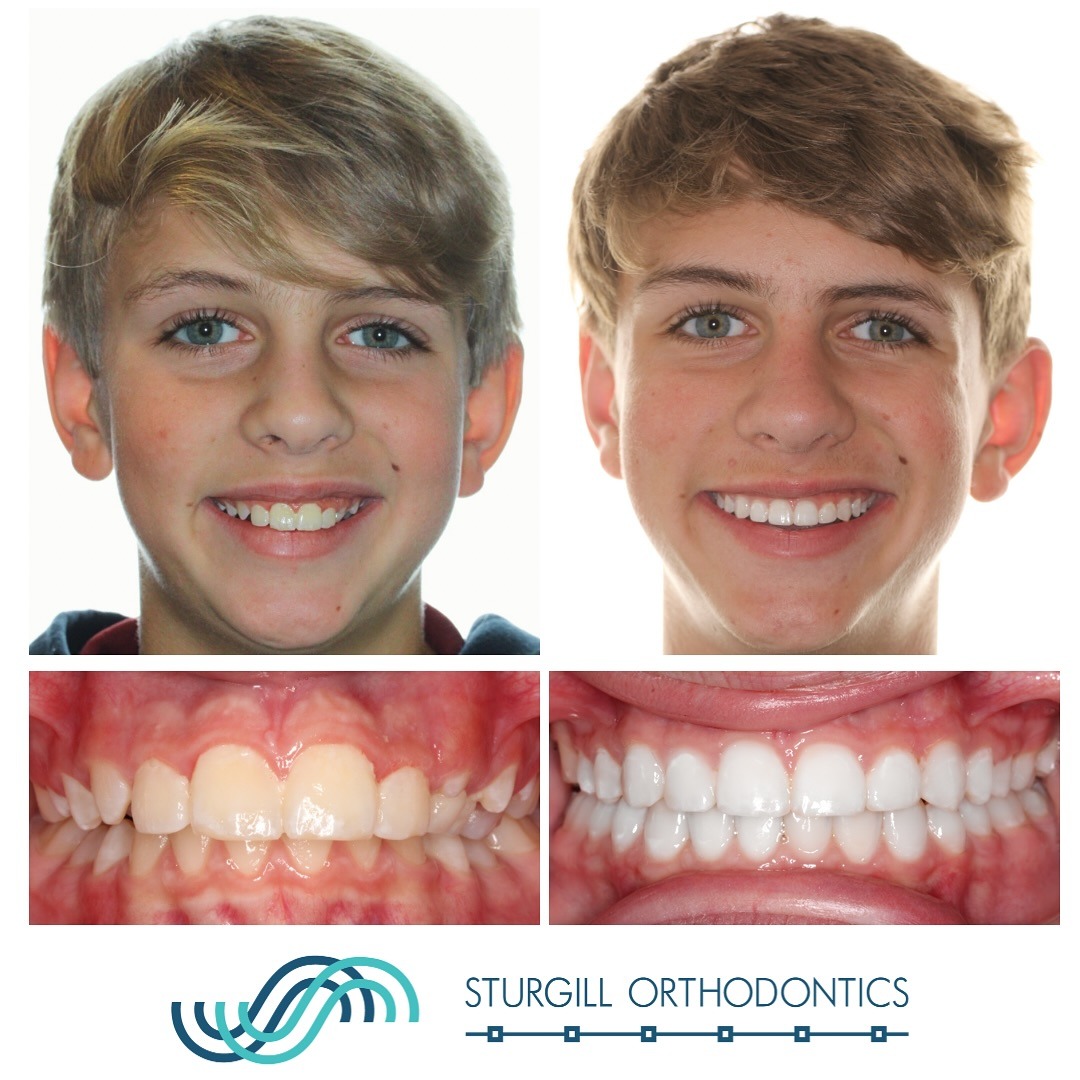
See how appliance treatment changes a smile.
Appliances That Hold Space
When a child loses a baby tooth too early, the neighboring teeth can drift into the empty spot. By the time the adult tooth tries to come in, there may not be room. A space maintainer is a simple, low-profile appliance that holds that space until the permanent tooth erupts. This often prevents the need for braces or extractions later.
Band-and-Loop Space Maintainer
Used to hold a single space, usually after the early loss of a back baby tooth. A metal band wraps around an anchor tooth, with a small loop of wire that rests against the next tooth, blocking it from drifting forward. Almost no maintenance and barely noticeable inside the mouth.
Lower Lingual Holding Arch
A wire that runs along the inside of the lower teeth, anchored to bands on the lower back molars. The lower lingual arch keeps the lower molars from drifting forward when baby teeth are lost too early, preserving space for the permanent teeth and the adult bite. Often used when a child needs space management on both sides of the lower arch at once.
Nance Appliance
Like the lower lingual arch but for the upper jaw. The Nance uses a small acrylic button that rests against the roof of the mouth, connected by wires to bands on the upper molars. It keeps the upper back teeth from drifting forward, which is useful both for holding space and for anchoring during certain orthodontic movements.
Appliances That Work Alongside Braces or Aligners
Elastics (Rubber Bands)
Tiny rubber bands stretched between the upper and lower teeth. They might look simple, but elastics do most of the heavy lifting on bite correction. The doctor sets the pattern, and the patient changes them several times a day. Wearing them as prescribed is one of the biggest factors that determines whether treatment finishes on time.
Separators (Spacers)
Small rubber rings placed between back teeth a week or two before bands are fitted. Separators create just enough space for the metal band to slide around the molar comfortably. They feel like food stuck between teeth at first; that pressure means they are working.
Temporary Anchorage Devices (TADs)
TADs are small titanium mini-screws placed gently into the bone between teeth, usually with topical numbing. They serve as a fixed anchor point so we can move specific teeth without other teeth shifting in the wrong direction. TADs have replaced headgear in many cases because they are entirely inside the mouth, low maintenance, and removed in a few seconds when their job is done. There has been a quiet revolution in adult orthodontics.
Bite Turbos and Bite Plates
Small acrylic stops, either bonded behind the front teeth or built into a removable plate, that prevent the back teeth from fully closing during treatment. They are commonly used to open a deep bite so the lower brackets do not get knocked off when the patient bites down.
Habit and Airway Appliances
Habit Appliances (for Thumb Sucking and Tongue Thrust)
Long-term thumb sucking, finger sucking, or a tongue-thrust swallowing pattern can push the front teeth forward, narrow the upper jaw, and create an open bite. A habit appliance, sometimes called a palatal crib, is a small fixed device that gently blocks the thumb or tongue from resting against the front teeth. Most kids stop the habit within a few weeks, and the bite often self-corrects with time.
Airway-Focused Appliances
A narrow upper jaw, large tonsils, or a recessed lower jaw can crowd the airway and contribute to mouth breathing, snoring, restless sleep, or pediatric sleep apnea. For children, expanders and growth-modification appliances can widen the airway during the years when bone is still flexible. For adults, custom oral appliances reposition the lower jaw at night to keep the airway open. We evaluate the airway during every comprehensive exam, not as an add-on, because we look at the whole child, not just the teeth. Addressing airway concerns early often supports better sleep and breathing alongside the bite correction.
How We Design and Build Appliances at Sturgill Orthodontics
Most of the appliances above used to require gooey impression trays and a wait of 1 to 3 weeks while a lab fabricated the device. That is not how we work.
- Digital scans replace impressions. An iTero scanner captures the teeth in a few minutes. No mold, no gag reflex, no “please do not move.”
- In-house 3D printing. We print many appliances on site, including custom retainers, which dramatically shortens turnaround when something is lost or damaged.
- Custom design per patient. Bonds, bands, and wire shapes are mapped to the actual contours of the teeth, which improves fit and comfort.
- Same-week appointments for fittings. If the doctor decides today that an expander is the right next step, we usually do not need a separate fitting visit weeks later.
All of this matters because a well-fitting appliance is a comfortable appliance. And a comfortable appliance is one that actually gets worn the way it should.
Who Should Fit Your Appliance?
Any general dentist can take an impression. Not every dentist is trained in the biomechanics of moving teeth, growing jaws, and stabilizing finished bites. An orthodontist completes 2 to 3 years of full-time residency after dental school, focused only on tooth movement, jaw growth, and appliance therapy. A board-certified orthodontist has gone a step further, passing rigorous written and oral exams from the American Board of Orthodontics. Only about 40% of practicing orthodontists hold this certification.
Every doctor at Sturgill Orthodontics is a board-certified orthodontist. When your child needs an expander, a Herbst, or a TAD placed, the person designing and fitting that appliance is a specialist who does this every day, in a practice focused only on orthodontics.
Caring for an Orthodontic Appliance
Specific care depends on the appliance, but a few rules apply to almost everything we fit:
- Brush around it, not just over it. Plaque hides at the edges of bands and brackets. A short electric toothbrush head and a Waterpik are worth the investment.
- Skip the foods that snap things off. Anything sticky (caramel is the big one, always avoid it), hard, or chewy in a stringy way (jerky, bagels, ice) can pop a bracket or bend a wire.
- Keep removable appliances in their case. Retainers wrapped in a napkin get thrown away. Always. Use the case.
- Clean removable appliances daily. Cool water, a soft toothbrush, and a non-abrasive cleaner. Hot water warps plastic.
- Call the office before improvising. If something feels loose, sharp, or does not fit, do not bend it back yourself. We can usually see you the same week and fix it properly.
Patients in active treatment should also know what counts as an orthodontic emergency and what can wait. We have a guide for that, too.
Frequently Asked Questions
What age should my child be checked for an orthodontic appliance?
The American Association of Orthodontists recommends a first orthodontic checkup around age 7. That does not mean every child needs treatment right away, but it lets us catch jaw growth issues, crossbite, crowding, and space problems while they may be easier to guide. For older kids and teens whose adult teeth are mostly in, we also offer Invisalign Teen and a full range of bracket and bite-correction appliances.
How long does it take to get used to a new orthodontic appliance?
Most patients adapt within 5 to 7 days. The first few days bring extra saliva, slightly altered speech, and a feeling of “there is something in my mouth.” By the end of the first week, most kids forget the appliance is there until adjustment day. Lisp and S-sound changes after a palatal expander or Hawley retainer almost always resolve on their own.
Do orthodontic appliances hurt?
There is usually pressure, not sharp pain. The first 24 to 72 hours after an appliance is placed or adjusted are the most uncomfortable, similar to the soreness after a workout. Soft food, ibuprofen or acetaminophen as directed, and warm salt-water rinses get most patients through it. If discomfort lasts longer than a few days or feels sharp, call us; something may need a small adjustment.
How much does a palatal expander or Herbst appliance cost in Johnson City?
When an expander or Herbst is part of comprehensive treatment, the cost is included in the overall fee, not billed separately. Stand-alone appliances (a single space maintainer, a replacement retainer) are quoted individually. We give every patient a written breakdown at the consultation, and we offer flexible payment plans with low down payments. Insurance, HSA, and FSA are all welcome. See our financing and insurance page for the full picture.
Are orthodontic appliances covered by insurance?
Coverage depends on your plan. Many orthodontic insurance plans help with appliances when they are part of comprehensive treatment, while stand-alone appliances may be covered differently. At your free consultation, we review your benefits, file the claim for you, and give you a written estimate before treatment begins so there are no surprises.
Can my child eat normally with an expander or Herbst?
Yes, with a few adjustments. Soft foods are easier the first few days. After the initial adjustment period, kids eat almost everything. The exceptions are sticky foods (caramel, taffy), hard foods (ice, hard candy, raw carrots), and anything chewy enough to bend wires (bagels, beef jerky). These can pop bonds and turn a smooth treatment into an unscheduled office visit.
Do I need a referral from my dentist?
No. Many of our patients come in directly, without a referral. If you suspect your child needs an expander, headgear, or another appliance, you can book a free consultation directly. We coordinate with your family dentist on records and continuing care.
My child was told they need headgear. Is that still a thing?
Less often than it used to be. We use headgear when it is clearly the best tool for a specific job, but in many cases TADs, the Forsus, expanders, or growth-modification appliances achieve the same result without the headstrap. At your consultation we will explain why a particular appliance was recommended, and what the alternatives look like.
Can adults use orthodontic appliances?
Absolutely. Adult orthodontics relies on the same toolbox, with some differences. Bone has stopped growing, so we cannot widen the upper jaw the way we can in a child without surgical assistance. But TADs, clear aligners, lingual braces, retainers, and surgical orthodontics when needed, all work beautifully for adults.
What happens if an appliance breaks?
Call the office. Most issues are not true emergencies, but they need a real fix, not a DIY one. We see broken or loose appliances quickly. For a full breakdown of what to do at home before your appointment, see our orthodontic emergencies guide.
Why Families Across the Tri-Cities Choose Sturgill Orthodontics
We are the most-reviewed orthodontic practice in the Tri-Cities, with more than 1,700 five-star Google reviews and the Johnson City Press Readers’ Choice Award for Best Orthodontist multiple years running. But the reasons families pick us tend to be more practical:
- Board-certified orthodontists at every visit. Specialists, not generalists, designing every appliance.
- Same-week appointments. When something breaks or a question cannot wait, you do not wait three weeks for a chair.
- Lowest down payments in the area. Treatment should not stall over the first invoice.
- Free consultations, no referral needed. You can find out exactly what is going on before you commit to anything.
- Three convenient offices. Johnson City, Bristol, and Norton, plus a coffee bar (Sturbucks) and our therapy dog Louie at the Johnson City office.
What families say about appliance care at Sturgill
“Started our braces journey this year for my child and it’s been such a great experience! Clean office, super nice staff, a therapy dog (Louie!), and a coffee bar. They always take the time to explain everything and work us in their schedule if we need to be seen for any reason at all. We saw Julie today for help with an expander and she was literally the sweetest.“
“We love this place! Dr. Sturgill and Williams are both fabulous. They let you know up front how much it will cost with no hidden costs. On a Sunday, my son’s expander popped off on one side and we had to call the on-call. Carla drove 30 minutes to come and remove the expander for my son. She was so gracious, kind, and happy to help even on the weekends.”
“Absolutely love this place! Keileigh was amazing and helped so much with my daughter when she got braces and expander on. The Drs here are amazing and all the staff is amazing. Every time we go we have an amazing experience. We are so grateful for the Drs and all their staff!”
Serving Johnson City and the Greater Tri-Cities
Our Johnson City office sits on Sunset Drive, easy to reach from anywhere in Washington County. We see patients from across Northeast Tennessee and Southwest Virginia, including Kingsport, Elizabethton, Gray, Jonesborough, Erwin, Piney Flats, and Blountville. Patients in our Bristol and Norton communities have local offices closer to home.
Find out which appliance is right for your smile.
A free consultation gets you a digital scan, a clear treatment plan, and a written cost breakdown. No referral required, no pressure.